Technology in the Ritual Arena: Towards a Sensory-Integrated Approach to Modernization in Sinhala Shantikarma
“A Sinhalese exorcism is intended to be beautiful; this is the crux of its seductive intensity, which, while it generates the impossible antinomies of existence, leads the way through to the realms of justice and the release from suffering” (Kapferer & Hobart, 2005, 18).
Imagine a ritual space that has endured across time, one that formed a world entirely its own: drum rhythms, choral chanting, dance movements, masks gleaming in the light of flambeaus, and beautifully crafted objects made from natural materials, all enveloped in a consecrated atmosphere that came alive especially in the night hours. Now place within it a tangle of black cables, a harsh white floodlight, and wired stand microphones positioned at the centre of the sacred arena (see. Nuwara Api, 2024). The tradition still survives, but something essential within it feels disturbed. This is something I have been familiar with since childhood, something I have witnessed many times, and something that has become a source of growing concern within me.
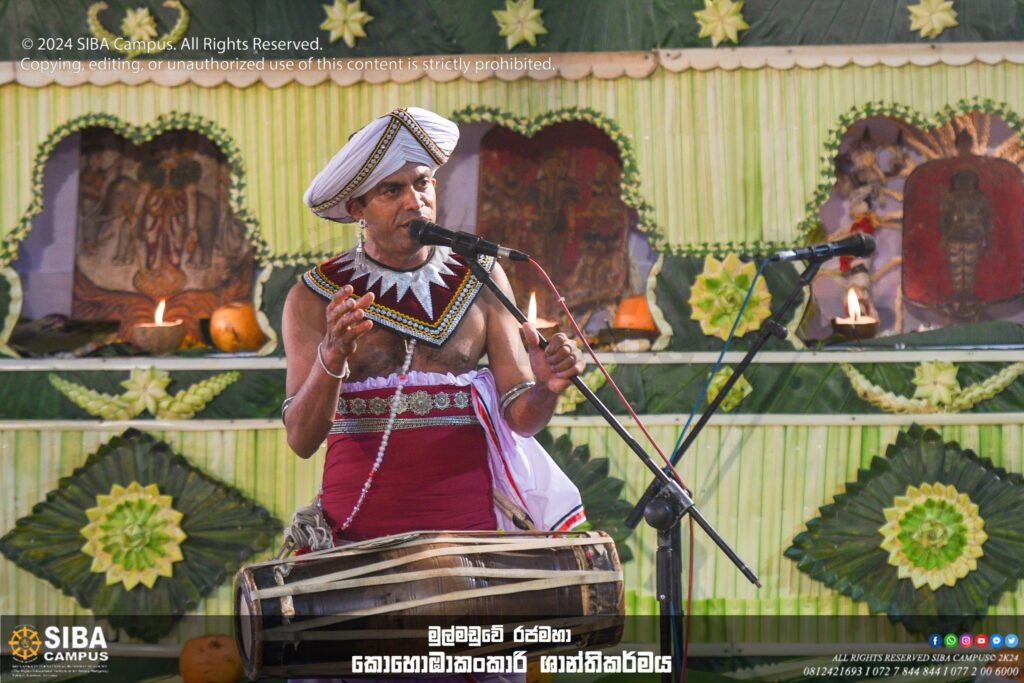
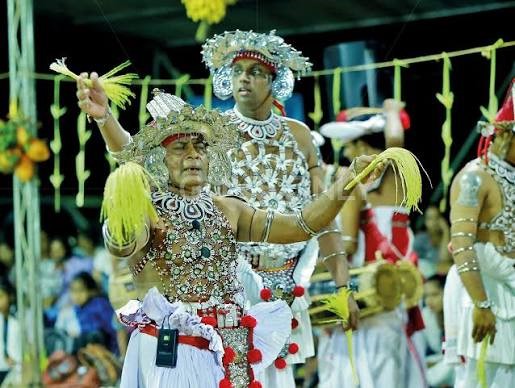
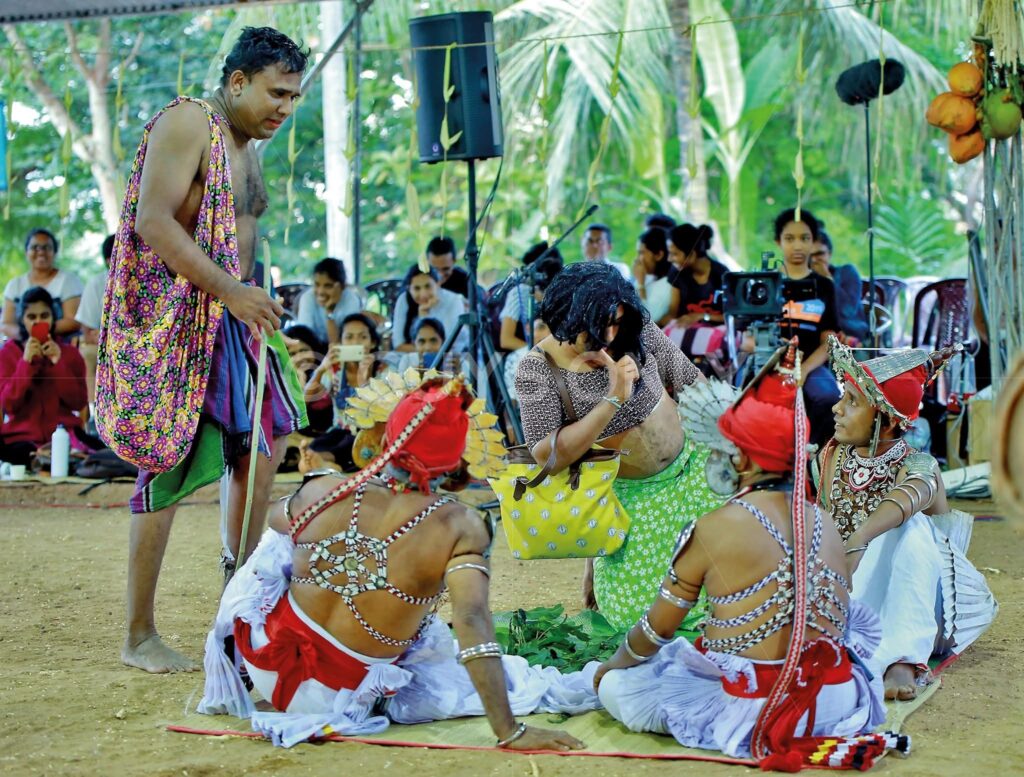
Shantikarma, performed for healing, propitiation, the restoration of cosmic balance, and prosperity, remains a living part of our cultural life. These traditions are sustained continuously through the dedication of traditional teacher lineages (guru parampara) who have carried this knowledge across many generations. Traditions such as Kohomba Kankariya, Bali Shantikarma, Madu Shantikarma, Daha-ata Sanni are not merely folk performances. They are complex ritual worlds built from the interplay of sound, light, space, costume, and movement. They are living heritage of real national significance that is truly our own, and the communities that sustain them deserve far greater recognition than they currently receive.
Even so, there is a tension I keep noticing in the present day. As audiences have grown and performance contexts have shifted, modern technologies such as amplification systems, electric lighting, and microphones have entered the ritual performance space, without anyone really asking whether these additions protect the true essence of these traditions or quietly destroy it. I want to be clear: this is not an argument against technology, and I am not opposed to it. Our traditions have always absorbed material changes. At some point, the flambeau (pandama) itself was a new invention. What I am trying to raise here is whether a technological change preserves or disrupts the internal sensory logic of the tradition.
That sensory logic is not something that can be dismissed as trivial. The sensory environment of a ritual arena (shantikarma maduwa), composed of its light, sound, spatial organization, and material qualities, is not mere decoration. It has functional value: it is the very medium through which the ritual world becomes present and real. I believe anyone who has sat within a properly conducted shantikarma will recognize this immediately. The yellow warmth of the flambeaus (pandam) does not simply illuminate the space. It creates an atmosphere charged with a quality of aliveness that belongs to the ritual itself. When harsh white electric light floods that same space, it does not merely add brightness; it reorganizes the entire sensory field. The fire’s glow is lost, and white costumes and silver ornaments are caught in the artificial light in ways that feel jarring and deeply uncomfortable. What was once unified becomes chaotic.
As I noted earlier, it is true that these rituals are partly changing because more people are coming to watch them. When a larger audience is present, practical demands arise: more light is needed, louder sound is needed. I do not view this simply as a corruption of our traditions. People coming to witness these ceremonies is, in many ways, a good thing. However, the new design challenge this creates does not seem to be something anyone is consciously addressing, and the consequences of ignoring it have been documented for decades. The anthropologist Susan A. Reed, writing about a Kohomba Kankariya held in Colombo in 1988, notes that “the entire spatial organization of the ritual hall was re-oriented to accommodate both the viewing audience and, more importantly, the television crew” (2010, 183). This disturbance was not only visual. Reed further records that “the yakdessas [ritual officiants] were expected to stand in front of a single standing microphone” for the convenience of recording. This arrangement forced the chief ritual officiant (mul yakdessa) to stand with his back to the altars, which was a direct affront to the deities being honoured by the ritual (2010, 183). What was introduced as a practical solution quietly dismantled something that was structurally essential to the ceremony. Beyond the spatial disruptions Reed documents, I have also observed problems with sound management in many performances. Microphones frequently fail to capture the voice clearly, and the balance between vocal sound and drum sound is rarely maintained, so that the two become competing rather than complementary elements. Given that the relationship between voice and drums is a structurally significant one in these traditions, this imbalance is not a minor inconvenience. Taken together, these spatial, ritual, and acoustic disruptions point to the same underlying gap: the absence of any principled thinking about how technology should behave in a ritual space.
What I propose, particularly in this twenty-first century with its advanced technology, is a mode of thinking about the use of technology in ritual spaces that I would call ritual-consonant design. This means shaping technology to work alongside the sensory logic of the tradition rather than against it, or developing technology specifically designed for this purpose. In practical terms, this could include warm-spectrum outdoor lighting that complements firelight rather than erasing it; wireless collar microphones produced in colours that match dance and drum costumes rather than clashing with them; and amplification systems that are concealed in ways that preserve sound quality without creating visual disorder, and properly calibrated amplification that balances vocal and drum sound as the tradition requires. This matters both aesthetically and spiritually. As Reed records, traditional practitioners are clear on this point. The view expressed by T.Y. Sumanaweera, a Kandyan ritual officiant, regarding the entirety of the Kohomba Kankariya’s dance sequences is equally relevant to the context we are discussing: “the efficacy lies in the whole, so when you take out bits and pieces it loses its power” (2010, 178). None of this is technically impossible. It simply requires someone to decide it matters.
The most critical point is that this cannot be designed by an outsider working alone. Any serious effort in this regard must place not only technical specialists but the teacher lineages (guru parampara) at its very centre. This is because the embodied knowledge held by those practitioners, concerning what a ritual environment should feel like, sound like, and look like, cannot be replicated in the same way by any outside researcher or designer. This is our tradition, and it is the people who carry it who must lead the conversation about how it changes. What I am therefore calling for is a carefully targeted research effort: first, to document the existing sensory norms within our living shantikarma traditions before unplanned modernization destroys them; second, to bring together practitioners, designers, and heritage specialists to collaboratively develop and test solutions; and third, to evaluate those solutions within actual ritual contexts, through the assessment of the practitioners themselves as well as the wider community of audiences.
These traditions have survived centuries of change, but whether they continue to survive will depend on the transmission of knowledge, community support, and institutional recognition. It will also depend on solving one further practical design challenge: how to bring light to a ritual arena, amplify the sound of a drum, and capture a chant without quietly dismantling something we have carried together for a very long time.
Reference
Kapferer, B., & Hobart, A. (2005). Introduction: The aesthetics of symbolic construction and experience. In A. Hobart & B. Kapferer (Eds.), Aesthetics in performance: Formations of symbolic construction and experience. Berghahn Books.
Nuwara Api. (2024, November 1). LIVE කොහොඹා කංකාරිය ශාන්ති කර්මය | Kohomba Kankaria Shanti Karma [Video]. YouTube. https://www.youtube.com/live/E3xZqIH8URI
Reed, Susan A. (2010). Dance and the Nation: Performance, Ritual, and Politics in Sri Lanka. Madison, Wisconsin: The University of Wisconsin Press.
Dilanjana M. Pathirana
Visiting Lecturer
Department of Kandyan Dance, SIBA Campus, Kandy
School of Music, SLTC Research University


