Brain Drain and Democratic Legitimacy: The Crisis of Public Trust in Sri Lanka
Introduction
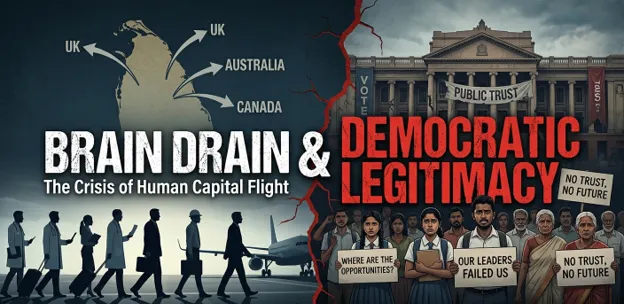
A foundational premise of democratic governance is that the authority vested in elected representatives derives from, and remains accountable to, a coherent, stable body of citizens, namely, the “public” in whose name that authority is exercised. In Sri Lanka, that premise is being structurally eroded. A 2025 study by the University of Peradeniya, reported in the Daily Mirror, reveals that over 50% of state university graduates are migrating permanently, with figures rising to 80–90% in critical fields such as medicine, engineering, and agriculture (Daily Mirror, 2025). When the educated citizenry departs en masse, the democratic ideals vested within the representative democracy within the constitutional supremacy model of Sri Lanka does not merely suffer a talent deficit but also a legitimacy crisis of a fundamental nature.
The Statistical Architecture of Exodus
Sri Lanka invests Rs. 87 billion annually in its higher education, educating approximately 42,000 undergraduates each year across disciplines spanning arts, management, engineering, and medicine (Daily Mirror, 2025). Yet this investment, financed by a population struggling with a poverty rate of 24.5%, is increasingly subsidising the intellectual capital of Western economies. Between 2022 and 2023 alone, over 1,800 doctors migrated abroad; in a year (ending May 2023), 842 graded medical officers and 274 specialist consultants departed the country. Nearly 900 university lecturers resigned their posts in 2023, and the demand for new passports surged 250% in 2022 (Ravihari et al., 2025). Free education, which is not a mere constitutional aspiration which even developed countries fail to do, but an ongoing reality to Sri Lankans, has become, in practice, a development aid programme for richer nations and thus has rendered the concept of the ‘public trust doctrine’ itself, to be obsolete.
The Public Trust Doctrine and Its Dissolution
The public trust doctrine, in its classical formulation, holds that the state holds certain fundamental resources and powers in trust for the benefit of the public at large. Transposing this framework into democratic constitutional theory, as many governance scholars increasingly do, the ‘public’ constitutes the beneficiary class whose interests the state is duty-bound to serve and whose consent legitimises governmental authority. The Lockean ‘social-contract’ itself presupposes a relatively stable conception, i.e., a body of persons who consent to governance, bear its burdens, and hold their representatives accountable.
When four out of every five graduates in technical and professional fields are exiting the country permanently, that beneficiary class is being systematically hollowed out. Who, then, remains to constitute the public in whose name governance is legitimised?
Sri Lanka’s democratic architecture risks becoming a formal exercise conducted over a population that is, in meaningful measure, composed of those who lacked either the qualifications or the means to leave. This renders a constituency structurally ill-positioned to elect, or meaningfully hold accountable, leaders of superior competence.
The Analogies of the Sheep and the Cattle
The analogy is uncomfortable but analytically precise and (is bluntly) as follows: every herd requires a shepherd, i.e., a leader of superior capability, not merely of similar disposition. Yet if democracy were applied to the sheep, they would choose one of their own. As such, a herd of cows does not choose a lion to lead it; it chooses another cow, of course, the most viable and their own favourite.
Thus, in a democracy corroded by brain drain, the electoral pool from which leaders emerge is drawn from precisely the segment of society that the state failed to retain. The outcome is structurally predetermined: a society that has exported its most capable people will, through entirely democratic means, select leaders from what remains. The democratic mechanism, operating perfectly and procedurally correctly, produces a leadership class that is the mathematical and probable expression of a diminished electoral constituency.
This is not a critique of democracy as a normative ideal. It is a critique of democracy operating in conditions for which it was not designed, as these are conditions of acute human capital flight, entrenched institutional corruption, and political patronage-driven governance.
As Ravihari et al. (2025) have analysed, top administrative appointments in Sri Lankan universities are determined by political connections rather than competence, promotions are contingent on patronage, and the structural disincentives to remaining compound with each successive government that reproduces the same pathologies.
Governance Failure as a Self-Reinforcing Mechanism
Munoz et al. (2025) identify political instability, weak rule of law, and deficient accountability as among the six principal drivers of brain drain across 178 countries, and as such, all of which Sri Lanka exemplifies acutely.
Thus, this becomes a cascading and self-reinforcing mechanism of organised chaos. Essentially, political instability generates inconsistent policy environments; inconsistency undermines long-term career planning for professionals; the exit of professionals further weakens institutional capacity; and weakened institutions generate further instability.
Dharmasiri (2024) and Sanjeewani and Cader (2025) identify the absence of competitive salaries and clear career pathways as proximate causes of departure, but the structural cause is deeper, as a political economy that rewards a nexus to power over meritocratic contribution and then also operating within a fiscal state so indebted, that it cannot compete (nor hope to compete) with remuneration available in the Global North.
Conclusion
Sri Lanka’s brain drain is not merely a human resources challenge; it is a constitutional and democratic emergency. When the most educated segment of the citizenry votes with its passport, and when free public education systematically finances foreign economies at the expense of a poverty-stricken populace, the legitimacy of democracy as a vehicle for national recovery must be interrogated, not assumed. Structural reforms are in dire need. Merit-based appointments, competitive remuneration, transparent governance, and sustained research investment cannot be considered as optional policy enhancements anymore; they are of utmost importance. They are the preconditions for the survival of democratic governance as anything more than a procedural ritual conducted by a dwindling constituency of the public over a nation which is, essentially, in free-fall. A shepherd does not emerge from the herd. Sri Lanka’s democracy will not reform itself through elections alone; it requires the structural conditions that make capable leadership both possible and probable.
References
Daily Mirror. (2025, February 27). Over 80% state university graduates are migrating. Daily Mirror. https://www.dailymirror.lk/breaking-news/Over-80-state-university-graduates-are-migrating/108-334050
Dharmasiri, A. D. U. (2024). Need for change in the current crisis of brain drain of health care professionals in Sri Lanka. Sri Lankan Journal of Nursing, 10(1).
Gunawardena, C., & Nawaratne, R. (2017). Brain drain from Sri Lankan universities. Sri Lanka Journal of Social Sciences, 40(2), 87–99.
Munoz, A. V., et al. (2025). The determinants of brain drain and the role of citizenship in skilled migration. MDPI. (In press).
Ravihari, K. M. V., Suriyabandara, V. S., & Madhushan, K. B. C. (2025). An analytical study of political impact on brain drain in Sri Lanka. International Journal of Social Science Exceptional Research, 4(6), 142–146. https://doi.org/10.54660/IJSSER.2025.4.6.142-146
Sanjeewani, P. N., & Cader, K. A. (2025). Understanding the impact of brain drain of academics and professionals on the Sri Lankan economy. Journal of Applied Learning, 8(1), 45–58.
Vinsuka Kannangara
PhD Candidate (University of Colombo)
Assistant Lecturer – University of Sri Jayewardenepura (Legal Studies Unit)
Accredited Visiting Lecturer – University of West London


