
Understanding Price Discrimination: Why the Same Product Costs Different for Everyone
- Introduction
In 1920, English economist Arthur Pigou of Cambridge University introduced the concept of Price discrimination in his theory of welfare economics, which was later developed by many prominent economists, including Joan Robinson, George Stigler and Paul Samuelson, in their studies of classical analysis of market, monopoly and monopolistic competition, the concept of price discrimination had been discussed and analysed. Since then, several studies have been carried out to emphasise the theory and prove its validity and applications, and it has become one of the prominent topics in economics, as several empirical evidence in favour of the fact that price discrimination is a more effective method to attract more customers, increase sales, and boost revenues and profits. (Alhabeeb, 2024)
According to studies, if a firm charges different prices for the same product or service depending on various factors such as the buyer’s willingness to pay, geographic location, age, or the time of purchase, price discrimination occurs, and it is widely used across different sectors of the economy to maximise profits and create efficiencies while capturing consumer surplus by setting prices at different levels for different market segments. Considering the customer’s behaviours, some people are willing to pay a higher price for one unit, while others express quite the opposite behaviour, under this ground, a firm sells its product for different prices depending on the segments of the consumers, it allows them to absorb total consumer surplus and transforms it into producer surplus.
Conventional economists explain price discrimination occurs when the same commodity is sold at different prices to different consumers, nevertheless, criticizing two limitations of this definition, Phlips et al. (1983) argued that it does not reflect transportation costs or other costs of selling the goods, and price discrimination take place even if all consumers are charged the same price. Machlup (1955) explained various economists have presented their definition contextually biased to areas such as Transportation and Public Utilities, antitrust problems, problems of unfair competition in Marketing, dumping, basing-point and delivered, price problems in Government Control of Business, problems of output determination in Pure Economic Theory, hence he has defined Price discrimination as “the practice of a firm or group of firms of selling (leasing) at prices disproportionate to the marginal costs of the products sold (leased) or of buying (hiring) at prices disproportionate to the marginal productivities of the factors bought (hired).” Stigler’s (1987) definition about price discrimination is when two or more similar goods are sold at prices that are in different ratios to marginal costs.
Price Discrimination is considered not only as marketing strategy, but also a method used create a monopoly, it is widely believed that it is required either some degree of monopoly power or a market which imperfectly competitive to exist Price Discrimination which is monopoly (Machlup, 1955) Further, Varian (1989) emphasized that in the theory of monopoly and oligopoly, Price discrimination arises naturally. Stole et al. (2007) further explained that price discrimination cannot exist, when there are markets which perfectly competitive and firms have neither short-run nor long-run market power. Manu studies have been carried out by economists to prove the presence of price discrimination in imperfectly competitive environments. Shepard (1991) gasoline service stations, Goldberg and Verboven (2005) European automobiles, Crawford and Shum (2001) cable television, Miravete and Roller (2003) cellular communications.
Not everywhere price discrimination can be implemented, there are conditions must be met for a firm to implement price discrimination. Carbonneau et al. (2004) have described that there are three criteria must be fulfilled to achieve price discrimination, those are the demands for a given good or service must be differed, a firm has market power, and the firm has the ability to prevent or limit arbitrage. Moreover, he clarified that if there are identical demand for product among customers, the same amount will be demand from good for each price which depend on the number of consumers and the firms’ supply in the market. Also, if firm has no market power, they cannot no longer affect its price and the law of one price will be applied. The ability to prevent or limit arbitrage of the firm is also important, otherwise, if a firm charge prices differently, customers will alleviate it by reselling.
Those are
- The producing firm must be imperfectly competitive for it has to have a full control over the price.
- The basis of differences such as time, quantity, customer, must be separable.
- The market must be segmental,
- The price elasticity of demand has to be different according to all of the bases of differences such as different quantities of product, different customers, and different time.
- Types of Price Discrimination
According to Arthur Cecil Pigou (1922) price discrimination can be categorized into three types.
- First-Degree Price Discrimination
- Second-Degree Price Discrimination
- Third-Degree Price Discrimination
- First-Degree Price Discrimination
This type of discrimination occurs, when producer sell each unit of a product separately and charge the maximum price a consumer is willing to pay, one of the notable things in this case is the ability of the producer to capture all of the consumer surplus, convert it completely into producer surplus. Every buyer is charged differently for the first unit purchase, while each buyer pays different prices for units purchased, hence the demand curve of discriminating monopolist is a composite of the demand curves of all potential buyers.
According to Pigou (1920) First-degree or perfect discrimination occurs, customers was charged of a different price against all the different units of commodity, such price charged was equal to its demand price, leaving no consumer surplus for the buyers. If all buyers are prepared to purchase one unit of a commodity and the seller sets a price equal to the buyer’s reservation price which is the maximum price the buyer is willing to pay for one unit. Alternatively, assume that all buyers have identical demand curves.
Many studies have mentioned the fact that this type of price discrimination is rare to find in the practical world, as it requires firms to know each consumer’s willingness to pay. Nevertheless, Tremblay (2019) stated that information barrier existed in the past, as now many online retailers use cookies to price discriminate for individuals. Further, he explained that if first-degree price discrimination is implemented in an alternative manner, if a merchant offers prices below the equilibrium price to all consumers, which is known as pareto price discrimination, then first-degree price discrimination benefits consumers.
Figure 1 illustrate, where the initial levels of consumer surplus (CS) and producer surplus (PS) are laid in competitive equilibrium. The competitive quantity is Q3, and the competitive price is P3. A monopoly could charge a price P2 at quantity Q2 to maximize profits with a single price.
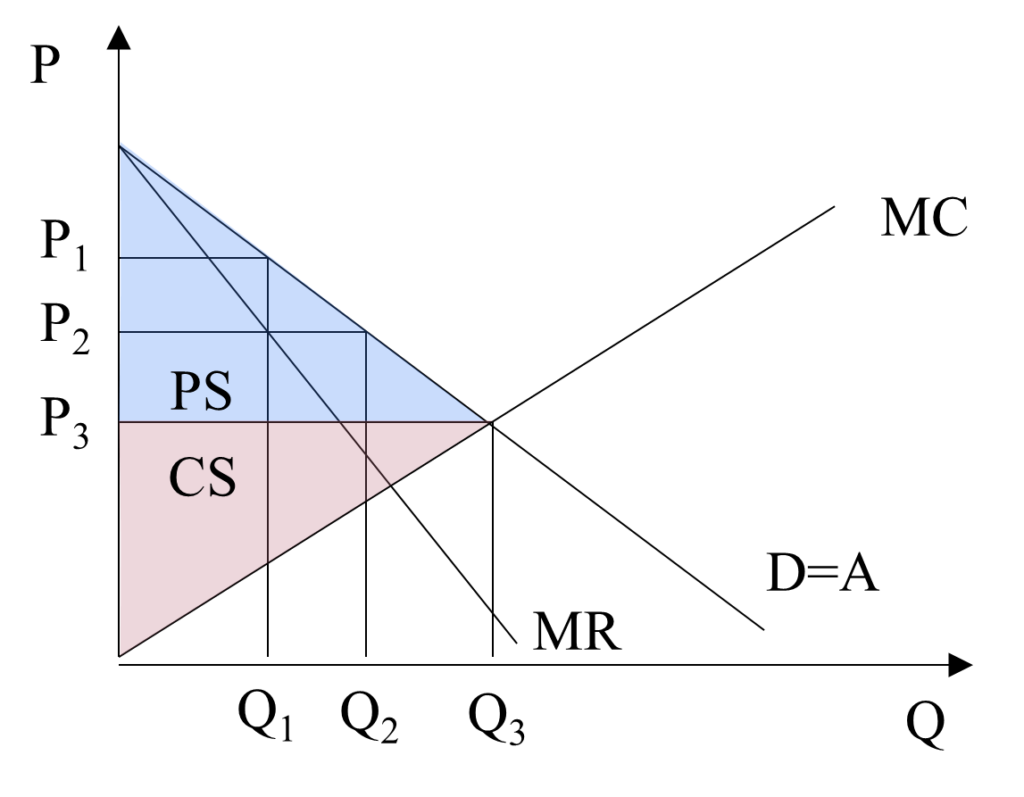
- P1 is a high price to capture consumers with high willingness to pay
- P2 is the monopoly price
- P3 is the competitive price
| Figure 1: Imperfect Price Discrimination |
Machlup (1955) explains that there are several forms of First-Degree Price Discrimination, one of them is the haggle-every-time type which appears only in a relatively unorganized market, where buyers are not regular customers with constantly recurring demand. The seller assesses each buyer’s ability to pay, capacity to demand, and knowledge of the market, and bargain as he can. The seller does not adopt any discounts policy or freight absorption, and the bargaining between seller and customer takes place only on price, terms, extra services, and delivery costs, if a customer tells he can buy the goods from a rival. The give-in-if-you-must is another type of discrimination that exists in markets where the buyers are regular customers with constantly recurring demand. Though there are numerous sellers, yet none have dominant, sell a little differentiated product in an unorganized and imperfect market where transactions are secret, and information of the market is primarily based on rumors. Deals are negotiated separately, and sellers are ready to make special concessions over deals. The let-him-pay-more type is a systematic but not important type of personal discrimination. Sellers are in a competitive position with little control over price, they have a few customers whom they can consistently overcharge. Although, Customers have free access to a more competitive market, are located so near the producer and so far from the central market that they fare better at a high discriminatory price than at the uniform market price. The size up his income type is type of discrimination often practiced by doctors and lawyers, charge is dependent on the affordability of clients or patients more specifically their income level or class. The Measure-the-use is a another one, contrast to other types, adjusting the price to the profits which buyer earns from selling or leasing. This practice is adapted for patents or copyrights which lease to users whose rental is fixed per unit of output or percentage of sales.
II. Second-Degree Price Discrimination
In this form, prices are sat based on the quantity purchased by the customer, differential prices are charged for blocks, acquiring a part of the consumer surplus. Companies provide the public utilities such as Power, gas and water companies adopt this second-degree price discrimination by offering a higher block rate for certain size of consumption, while the charge for per unit decreases as the size of consumption increases. If a firm wants to implement second degree Price Discrimination, not only the firms need to know more details about the demand curves of their consumers, but also, it must be able to measure the product consumption.
Machlup (1955) define this type as a semi personal, as it depends on the variance between different group of customers, while the advantage is taken of those differences, it avoid the ability of customers to evade discriminatory prices. In this form price discrimination takes place based on prices, the gender, civil status, membership, location, and nature of customers. Charging prices over occupational categories such as educational, personal and enterprises and different subscription rates are examples for this form. Also, it may occurs based upon the location of the customer or his status such as special rates for new customers, or quantity and volume discounts to oldest ones.
Further McAfee (2008) explained second degree as indirect price discrimination which allows customers a range of products in varying of quality, features, prices and quantities, in some forms consumers are required to buy more than one product, while firms offer all consumers the same set of choices but allow consumers to sort themselves into groups with differing levels of demand. Further he explained about several forms of second-degree price discrimination.
Quantity discounts are one form of second-degree discrimination where customers can buy one, get the second at half price, it is transparent from the fact that the units are sold at different prices. Coupons are another example for second-degree discrimination, they function on the value of time rather than the scale of demand. Individuals value their time at approximately their wages, and people with low wages are the most price-sensitive, also have the lowest value of time. Coupons are pieces of paper issued by grocery stores to redeem some amount of price for an item, usually come in newspaper bundles, and used by relatively poor consumers, it offer to the seller to apply a price cut that is approximately targeted at the more price-sensitive group. Bundling discounts is another form whichoccurs when the price for one product is reduced if the consumer also buys another product. There are two variants of bundling, pure bundling is consumer can only purchase the products as bundle and it is not allowed to buy an individual item, and mixed bundling, the firm sets prices for a bundle and also for individual items.
III. Third-Degree Price Discrimination
This type of price discrimination occurs when firm adopts a price setting strategy to release goods or services into the market in different segments and charges them different prices for the same product. It is considered one of the well-known market strategies which has been successfully used in many fields and industries such as Travel and tourism, airline, food, retail, pharmaceutical and more. (Alhabeeb, 2024; Varian, 1989) It is also called product discrimination, buyers will separate themselves and buy at discriminatory prices. A seller implements this by differentiating his products as to design, label, quality, time of sale, or distribution channel having a different appeal to different consumers or by offering different products.
Online marketplaces often resort to price discrimination when dealing with a heterogenous population of sellers. For instance, Amazon and eBay charge different commission rates depending on the product category, Apple and Google discriminate between large and small developers, by charging a higher commission rate (30% for large and 15 for small scale) for developers with more than $1m annual revenue (Mantovani et al., 2023)
Tremblay (2019) explained that the third-Degree Price Discrimination also can be seen on online markets, Capital One-an American insurance company has offered different interest rates for the same loans depending on the users’ web browser; similarly, Orbitz-a travel fare aggregator website posted higher prices to Mac users than to other PC users.
Segmenting consumers based on a certain aspect such as age groups is the most common example for the third-degree price discrimination, in real world movie ticket or medicine discount are offered for seniors, kids, students or veterans. In addition, Certain occupations can be qualified for certain discounts such as books and stationary supplies discount for teachers and university students. In some cases, members of union, guild or certain association qualify for a discount, also Gender can be a factor to receive for certain discount. Further, coupons discounts also can be considered a form of third-degree price discrimination when it aims to attract a specific segment of customers such as those who are price-sensitive with elastic demand, or those who have time enough to spend on collecting coupons out of newspaper, magazines, and computer ads.
References
Carbonneau, Shane and McAfee, Randolph Preston and McAfee, Randolph Preston and Mialon, Hugo M. and Mialon, Sue H., Price Discrimination and Market Power (June 7, 2004). Available at SSRN: https://ssrn.com/abstract=594442 or http://dx.doi.org/10.2139/ssrn.594442
J., Alhabeeb. (2024). Price Discrimination as a Marketing Strategy. International Journal of Marketing Studies. 11. 1-1. 10.5539/ijms.v11n4p1.
Machlup, F. (1955). Characteristics and Types of Price Discrimination. 397–440. https://www.nber.org/books-and-chapters/business-concentration-and-price-policy/characteristics-and-types-price-discrimination
Phlips, L., Phlips, & Louis. (1983). The Economics of Price Discrimination. https://EconPapers.repec.org/RePEc:cup:cbooks:9780521283946
Stole, L., Stole, & Lars. (2007). Price Discrimination and Competition. 3, 2221–2299. https://EconPapers.repec.org/RePEc:eee:indchp:3-34
Varian, H. R. (1989). Chapter 10 Price discrimination. Handbook of Industrial Organization, 1, 597–654. https://doi.org/10.1016/S1573-448X(89)01013-7
Goldberg, P. and F. Verboven (2005) “Market integration and convergence to the Law of One Price: evidence from the European car market,” Journal of International Economics, 65: 49-73.
Shepard, A. (1991) “Price discrimination and retail configuration,” Journal of Political Economy, 99: 30-53.
Crawford, G. and M. Shum (2001) “Empirical modeling of endogenous quality choice: the case of cable television,” working paper.
Miravete, E. and L-H. R¨oller (2003) “Competitive nonlinear pricing in duopoly equilibrium: the early U.S. cellular telephone industry,” working paper.
M.M. Samadhi Abhisheka Karunarathna
B.G.L.A Siriwardhana
Department of Economics
University of Sri Jayewardenepura

You may also like

The China-India power rivalry and Sri Lanka
